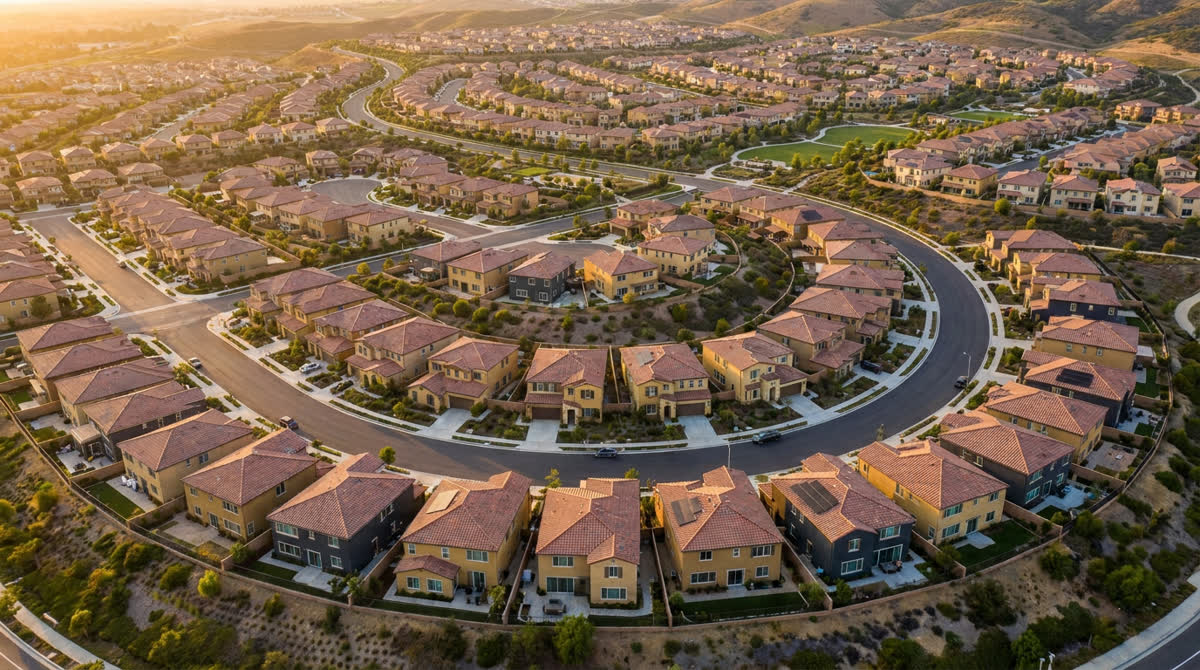
Why do two identical homes have wildly different tax bills? Often it's Mello-Roos — an extra charge stacked on top of base property tax in newer communities. Here it is, visualized.
Two layers, one bill
Property owners in newer Ventura County and San Fernando Valley communities often open their annual tax bill to find two distinct charges. The first is the familiar base property tax — roughly 1.1% to 1.25% of assessed value, made up of the 1% Proposition 13 rate plus local voter-approved bonds. The second, stacked right on top, is the Mello-Roos (Community Facilities District, or CFD) assessment. The infographic shows exactly that: an older neighborhood pays the base layer only, while a Mello-Roos district pays the base plus the CFD, for a higher total.
The key insight is that these are additive. Mello-Roos does not replace your property tax — it's an extra charge layered on top, which is why two identical homes can have very different total bills depending on whether one sits in a CFD.
What Mello-Roos actually pays for
When a developer builds a new community, the infrastructure — streets, sewers, schools, parks, sometimes police and fire facilities — has to be funded. Rather than raise everyone's taxes, a Community Facilities District is formed and the homeowners within it repay bonds that financed that infrastructure. The charge is typically a fixed or modestly escalating annual amount, often running from a few hundred to several thousand dollars depending on the tract.
- It's usually not tied directly to your home's value the way base property tax is.
- Many districts have a defined payoff term (commonly 25–40 years), after which the bond portion ends — though some services components continue.
- It's disclosed to buyers and appears as a line item on the county tax bill.
Why it matters when you buy
Because Mello-Roos stacks on top, it directly raises your monthly housing cost and can shift which homes are truly affordable. A newer home in a CFD might carry hundreds of dollars a month more in taxes than an older home at the same price — money that doesn't build equity. That's not a reason to avoid these communities; the newer construction and amenities are often worth it. But it is a reason to check the specific CFD amount and remaining term before you write an offer, and to run the full number through an affordability calculator that includes it.
Amounts vary tract by tract, so the bars here are illustrative. Confirm the exact Mello-Roos figure on the property's disclosures and the county tax bill, and ask how many years remain on the bonds.
The stacking, visualized
Frequently Asked Questions
Does Mello-Roos replace my property tax?
No. It's an additional charge stacked on top of your base property tax (about 1.1% to 1.25% of value). Two identical homes can have very different total bills depending on whether one sits in a Mello-Roos district.
What does Mello-Roos pay for?
Infrastructure in newer communities — streets, sewers, schools, parks, and sometimes public-safety facilities. Homeowners in the Community Facilities District repay the bonds that financed it.
How long does Mello-Roos last?
Many CFD bonds have a defined term, often 25 to 40 years from formation, after which that portion ends. Some districts have ongoing services components. Check the remaining term for the specific tract.
How much is Mello-Roos?
It varies widely by tract, commonly from a few hundred to several thousand dollars a year, and is usually not tied to your home's value. Confirm the exact figure on the property disclosures and the county tax bill.
