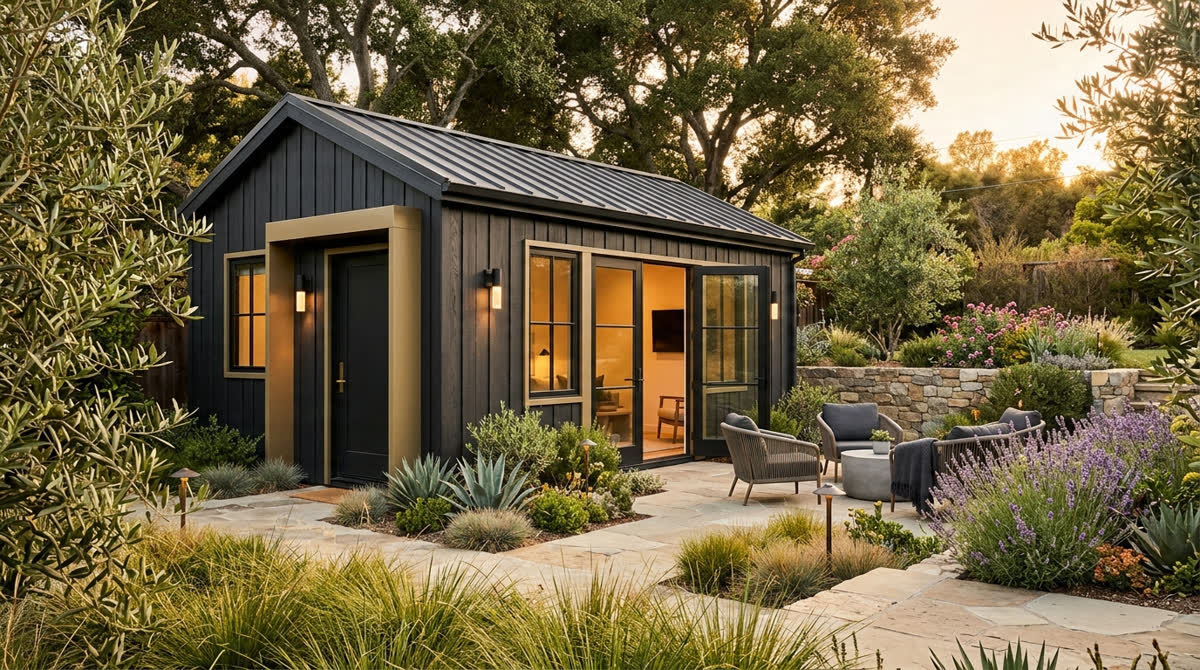
An accessory dwelling unit is one of the few improvements that can pay for itself in the Ventura County and Conejo Valley market, because local rents are high relative to what it costs to build. This calculator estimates the rental return on a new ADU by city — net operating income, annual cash flow, cash-on-cash return, payback period, and the value the unit adds — with typical build-cost and rent presets you can override with your own bids. Treat the presets as planning figures; the real numbers come from contractor bids for your specific lot and a current rent survey of your neighborhood.
Estimate your ADU return
Pick a city to load typical figures, then adjust to your bids. The calculator runs entirely in your browser — nothing is saved or transmitted.
Estimate only. Presets are regional 2026 planning figures, not quotes. Value-add uses an income approach at a 5.5% cap rate and is not an appraisal. Confirm build cost with contractor bids, rent with a local survey, and financing with your lender. Not financial or investment advice.
Typical figures by city (2026 planning estimates)
These are regional planning ranges for a detached 600–800 sq ft ADU, not quotes. Build cost varies most with site conditions and finishes; rent varies with neighborhood and unit quality. The calculator loads the midpoints below — always replace them with contractor bids and a current rent survey.
| City | Typical build (all-in) | Typical rent / mo |
|---|---|---|
| Simi Valley | ~$185,000 | ~$2,400 |
| Moorpark | ~$185,000 | ~$2,400 |
| Camarillo | ~$190,000 | ~$2,500 |
| Thousand Oaks | ~$200,000 | ~$2,700 |
| Newbury Park | ~$200,000 | ~$2,650 |
| Oak Park | ~$205,000 | ~$2,800 |
| Westlake Village | ~$235,000 | ~$3,300 |
| Calabasas | ~$240,000 | ~$3,400 |
How the math works
Net operating income (NOI). Annual rent minus operating expenses — property tax on the new construction, insurance, maintenance/reserves, vacancy, and any management. The calculator defaults to 28% of rent for these combined; owner-managed units with newer construction can run lower, while higher-tax cities or pricier maintenance push it up.
Cash-on-cash return. Annual cash flow divided by the cash you actually put in. If you pay cash for the build, cash invested equals the build cost and cash flow equals NOI. If you finance part of it, cash invested drops to your out-of-pocket portion and cash flow is NOI minus the loan's annual debt service. Leverage can raise the percentage return when rent comfortably covers the payment — and hurt it when it doesn't.
Payback period. Cash invested divided by annual cash flow — how many years of rent it takes to recover what you put in. In this region a cash-funded ADU often pays back in roughly 9–13 years and then produces income for decades.
Value added. Beyond rent, an income-producing ADU adds resale value. Appraisers increasingly capitalize the ADU's NOI at a local cap rate; the calculator uses 5.5% as a regional midpoint, which often returns a value-add near or above the build cost. The actual figure depends on the appraiser and comparable sales with ADUs.
What drives ADU returns in this market
- Build efficiency. The single biggest variable. A clean, flat lot with utilities nearby and a standard floor plan builds for far less than a hillside lot needing grading, a long sewer run, or custom design. Garage conversions and prefab/modular units can cut cost meaningfully.
- Rent positioning. A well-finished detached unit with its own entrance, in-unit laundry, and a small private yard rents at the top of the range and stays occupied. Studio and one-bedroom units lease fastest in this market.
- Financing cost. ADU construction is typically funded with a HELOC, cash-out refinance, renovation loan, or construction loan — generally at rates above a first mortgage (the calculator defaults to 7.5%). The cheaper your capital, the better the cash-on-cash.
- Tax treatment. Only the new ADU's assessed construction value is added to your property tax base; your home keeps its Proposition 13 basis. As a rental, the ADU also opens depreciation and expense deductions — talk to a CPA.
- Multigenerational use. Many owners build to house a parent or adult child and rent later. Even when not rented, an ADU's value-add and optionality are real — and the rent figure becomes "rent saved."
The rules that make ADUs work in California
California's statewide ADU laws (Government Code §66310 and following) require cities to permit ADUs on most residential lots, cap fees, limit setbacks and parking demands, and impose ministerial (non-discretionary) approval within set timelines. Local ordinances still control specifics — maximum size, height, and design — so check your city's current ADU rules and Ventura County or Conejo Valley fee schedules. Owner-occupancy mandates for new ADUs were suspended statewide through January 1, 2025 and many cities continue not to require them. Short-term-rental rules vary widely; long-term rentals are broadly permitted.
Frequently Asked Questions
What is a good cash-on-cash return on an ADU?
In this region, 7–10% is solid and above 10% is strong, because rents are high relative to build cost. A cash-funded, efficiently built 600–800 sq ft detached unit often lands in that range. Financing lowers cash invested and can raise the percentage if rent covers the debt service.
How much does an ADU cost to build in Ventura County in 2026?
As a planning range, about $180,000–$260,000 all-in for a detached 600–800 sq ft unit, depending on city, finishes, and site conditions. Garage conversions can be cheaper; high-end Calabasas/Westlake builds run higher. Get contractor bids.
How much value does an ADU add to a property?
Appraisers increasingly capitalize the ADU's net operating income at a local cap rate (around 5–6%), often producing a value-add near or above build cost. The actual figure depends on the appraiser and comparable sales with ADUs.
Can I rent out an ADU in California?
Yes. Statewide ADU law requires cities to permit ADUs on most residential lots. Long-term rentals are broadly allowed; short-term rules vary by city. Confirm your city's current ordinance.
Does an ADU increase my property taxes?
Only partially — California adds the new ADU's assessed construction value at roughly 1.1–1.25% per year. Your existing home keeps its Prop 13 base. Build the added tax into the expense percentage.
